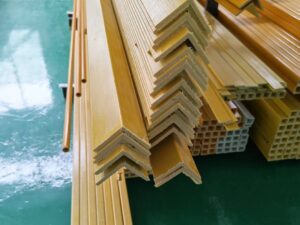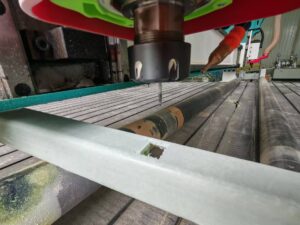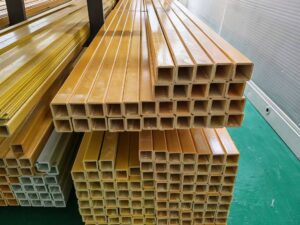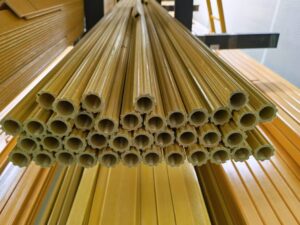
Pultruded FRP fiberglass flat bar — non-conductive, corrosion-proof flat stock for backing, bracing, plates & fabrication. Made in USA. Request a quote.
Description
Crimar Composites pultruded FRP flat bar (plate strip) is a non-conductive, corrosion-proof flat stock for backing, bracing, spacers, trim, cover plates, and fabricated components in harsh environments. Multiple widths and thicknesses. Manufactured in the USA.
Why Flat Bar in FRP
- Non-conductive & RF-transparent — safe around energized equipment; reduces shock and arc-flash exposure.
- Corrosion-proof — immune to chlorides, acids, alkalis, and H2S; no rust, no rot.
- Lightweight — roughly one-quarter the weight of steel; faster, safer installs.
- Low maintenance — no painting, no re-galvanizing, no replacement cycle.
- Engineered strength — high strength-to-weight with predictable performance.
Standard Sizes (representative)
| Width | Thickness |
|---|---|
| 1″ | 1/8″ |
| 1″ | 1/4″ |
| 2″ | 1/4″ |
| 2″ | 3/8″ |
| 3″ | 3/8″ |
| 4″ | 1/2″ |
| 6″ | 1/2″ |
Widths to 6″, thicknesses 1/8″–1/2″. Custom sizes on request. Standard stock length 20 ft (6 m).
Mechanical Properties (representative)
| Property (lengthwise) | Test method | Representative value |
|---|---|---|
| Glass content (by weight) | — | 50–65% |
| Density | ASTM D792 | 1.7–2.1 g/cm³ (0.062–0.076 lb/in³) |
| Tensile strength | ASTM D638 | ≈ 30,000 psi (207 MPa) |
| Flexural strength | ASTM D790 | ≈ 30,000 psi (207 MPa) |
| Compressive strength | ASTM D695 | ≈ 30,000 psi (207 MPa) |
| Full-section flexural modulus | EN 13706 / ASTM D198 | E17 ≥ 2.5×10⁶ psi (17 GPa); E23 ≥ 3.3×10⁶ psi (23 GPa) |
| Barcol hardness | ASTM D2583 | ≥ 40 |
| Water absorption | ASTM D570 | ≤ 0.6% |
| Flame spread (FR grade) | ASTM E84 | ≤ 25 (Class 1) |
| Max service temperature | — | ≈ 150 °F (65 °C) standard; higher with special resins |
Resin Systems
Standard isophthalic polyester for general corrosion and outdoor service; vinyl ester for aggressive chemicals, coastal sites, and battery rooms; fire-retardant (FR) grades where ASTM E84 Class 1 flame spread is required. All resin systems are electrically non-conductive.
Typical Applications
- Backing bars and splice plates
- Bracing, spacers, and shims
- Cover and trim strips
- Ladder rungs and components
- Fabricated brackets and supports
- Edge protection and nailers
Industries Served
- Water & wastewater treatment
- Chemical processing
- Electrical utilities & substations
- Oil & gas
- Mining & mineral processing
- Marine & coastal
- Cooling towers
- Solar & renewable energy
- Infrastructure
- Transportation
Standards & Compliance
- ASTM D3917 — dimensional tolerances for pultruded shapes
- ASTM D638 / D790 / D695 — tensile, flexural, compressive properties
- ASTM D2583 — Barcol hardness · ASTM D570 — water absorption
- ASTM E84 — surface burning (Class 1 with FR resin)
- ASCE Pre-Standard for LRFD of Pultruded FRP Structures — structural design
- EN 13706 (grades E17 / E23) — international standard for structural pultruded profiles
- ISO 9001 quality management — available on request
Values and sizes shown are representative engineering ranges for pultruded FRP and are provided for preliminary selection only. Request Crimar’s product datasheet for certified values for your specification. Manufactured in the USA.
Part of the Pultruded FRP Profiles Line
See the full line on the Pultruded FRP Structural Profiles overview, or browse all Pultruded FRP Profiles. Related: FRP Grating · Accessories & Hardware.
Explore All Profile Shapes
- FRP Angle
- FRP Channel
- FRP I-Beam & Wide-Flange
- FRP Square & Rectangular Tube
- FRP Round Tube
- FRP Flat Bar (this page)
- FRP Solid Rod
- Custom Pultruded Profiles
Frequently Asked Questions
Is FRP flat bar electrically conductive?
No. Crimar pultruded FRP is electrically non-conductive and RF-transparent, which is why it is specified around energized equipment, in substations, and near instrumentation.
What sizes does the FRP flat bar come in?
Flat bar widths to 6″ and thicknesses 1/8″–1/2″; custom sizes on request. Standard stock length 20 ft (6 m).
Which resin system should I choose?
Isophthalic polyester for general corrosion and outdoor use; vinyl ester for aggressive chemicals, coastal sites, and battery rooms; fire-retardant (FR) grades where ASTM E84 Class 1 flame spread is required. All resins are non-conductive.
Is FRP more expensive than steel?
FRP usually costs more up front but less over its life: it needs no painting, galvanizing, or replacement and resists the corrosion that forces steel to be replaced. On corrosive or energized sites the total cost of ownership is typically lower.