FRP grating comes in two main families — molded and pultruded — and choosing the right one comes down to load, span, and how the panel is used. Both are corrosion-proof and non-conductive; they differ in how they carry load.
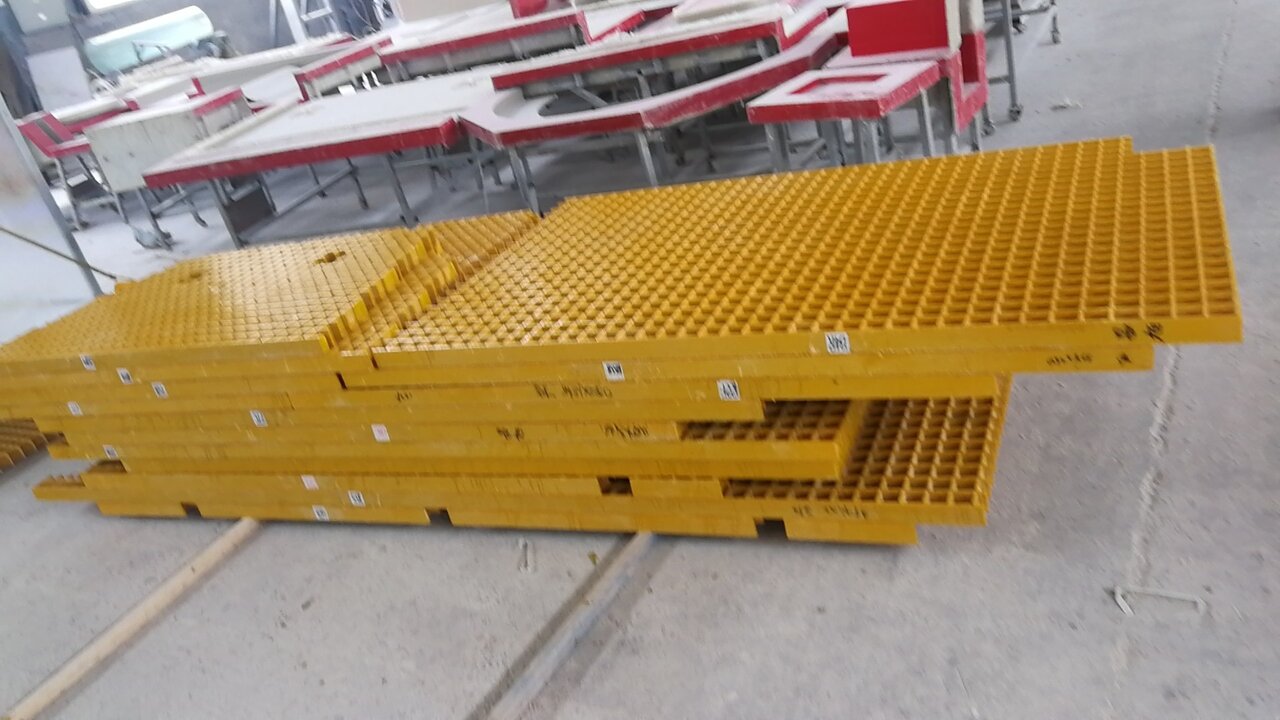
Molded grating
Molded grating has load-bearing bars running in both directions, giving it excellent corrosion resistance, a high open area, and easy field cutting with minimal waste. It is ideal for walkways, platforms, trench covers, and moderate spans where bi-directional support and chemical resistance matter most.
Pultruded grating
Pultruded grating uses high-strength bearing bars in one direction, giving it higher load capacity over longer spans. It is the better choice for long-span platforms, heavy or point loads, and vehicle traffic.
Quick comparison
| Molded | Pultruded | |
|---|---|---|
| Load direction | Bi-directional | High unidirectional (bearing-bar) |
| Best for | Corrosion, panels, moderate spans | Long spans, heavy / point loads |
| Open area | ~60–70% | ~40–60% |
| Field cutting | Easy, low waste | Bearing-bar direction matters |
| Typical use | Walkways, platforms, trench covers | Long-span platforms, vehicle / heavy loads |
Don’t forget deflection
FRP has a lower modulus than steel, so grating is usually deflection-governed, not strength-governed. Specify the allowable deflection (for example L/200) up front, along with the uniform and any point/vehicle loads, and the span — those drive the depth and type.
Surface and resin
Both types come with a gritted or concave anti-slip surface and a choice of resin (isophthalic polyester, vinyl-ester, or fire-retardant) selected for the environment. All are non-conductive.
Get help choosing
See our FRP grating page, then send us your load, span, allowable deflection, and environment and we will recommend the right grating and provide a quote.