Industrial off-gas handling is one of the most demanding jobs in composites. Ductwork carrying corrosive, high-temperature process gas has to survive sulfur-bearing gases, acidic condensate, abrasive solids, vacuum, and constant thermal cycling — and still run for decades. Get the material and structural design right and FRP ductwork far outlasts metal; get it wrong and it fails early.
A real-world engineering evaluation
Crimar’s engineering team was recently engaged to evaluate replacement options for a large FRP duct system in a demanding metallurgical process. The existing duct had run for decades under severe service — itself a testament to well-designed composites — and the facility wanted to apply modern materials and methods to support future reliability. The project is a useful illustration of how material science, sound engineering, and long-term thinking come together in critical process equipment.
The service conditions
The duct operated under conditions that punish most materials:
- Elevated operating temperatures approaching 80 °C (176 °F)
- Sulfur dioxide (SO2)-rich process gas
- Acidic condensate exposure
- Continuous vacuum service
- Heavy solids accumulation and loading
- Extreme seasonal temperature swings
- Wind and maintenance loads
Evaluating material options
Choosing the right composite system is the heart of the job in aggressive chemical service.
Conventional FRP (vinyl-ester) construction
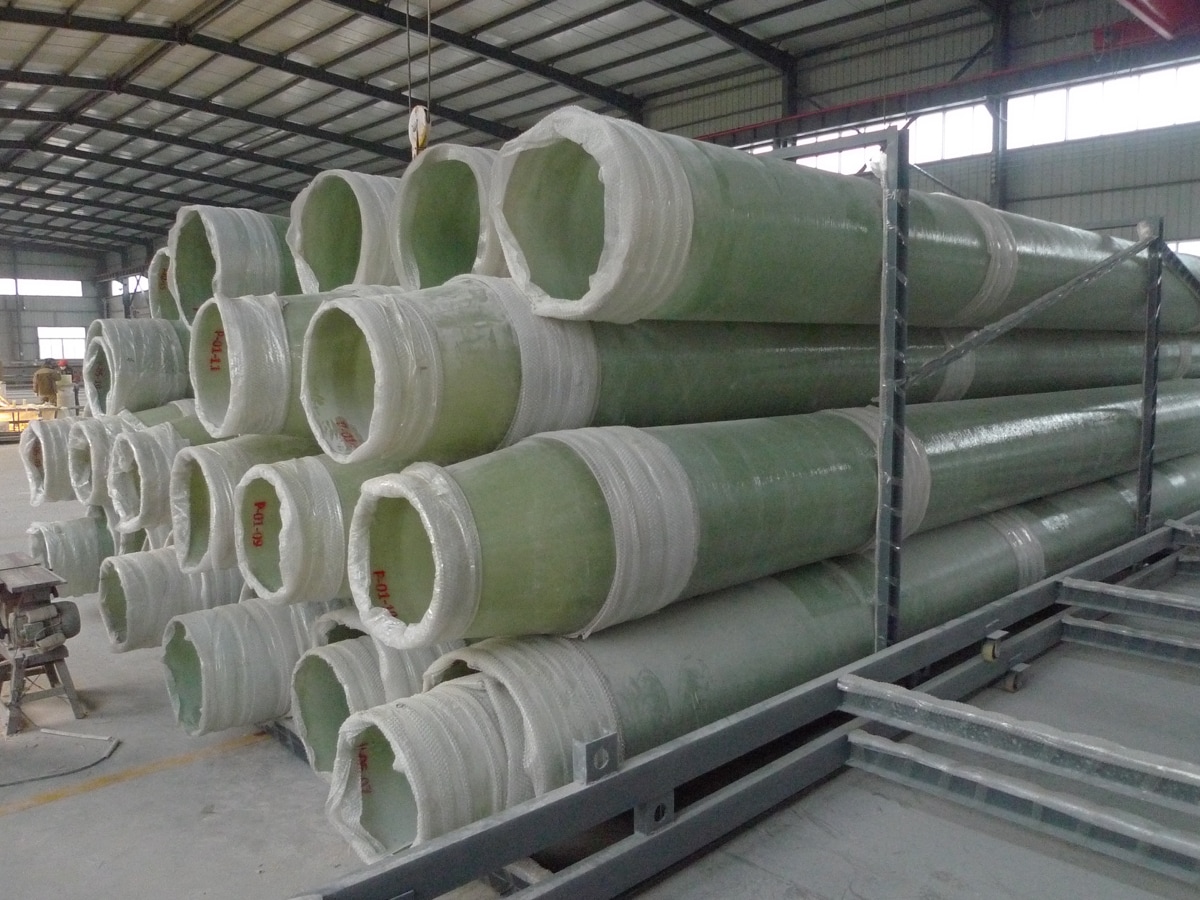
Vinyl-ester resin reinforced with corrosion-resistant glass remains the industry standard for flue-gas and chemical-process duct. Properly designed FRP ductwork offers:
- Excellent corrosion resistance
- Proven long-term performance
- Cost-effective lifecycle economics
- Ease of fabrication and installation
Carbon-fiber reinforcement
For select high-temperature applications, carbon-fiber reinforcement can add:
- Higher stiffness-to-weight ratio
- Improved dimensional stability
- Lower thermal expansion
- Optimized support and expansion-system design
Whether the added investment in carbon fiber delivers a meaningful operational advantage depends on the application — it warrants a detailed engineering review, not a default specification.
Good duct design is more than wall thickness
In corrosive gas service, the structural calculation is only part of the picture. Engineers also have to evaluate:
- Resin selection
- Corrosion-barrier construction
- Surface veil materials
- Reinforcement architecture
- Thermal expansion effects
- Chemical compatibility
- Long-term aging behavior
A system that performs well at moderate temperature can behave very differently as temperatures rise. For that reason, material recommendations should be based on the complete operating environment — not a single design parameter.
Designing for long-term reliability
Many plants still run composite equipment installed decades ago. When it is time to replace, owners face a real question: should the new design simply meet current code, or carry additional margin informed by decades of proven field performance? We believe the best projects balance modern engineering standards, historical operating experience, maintenance accessibility, total lifecycle cost, and long-term reliability — so clients get maximum value from the capital investment while minimizing future downtime risk. (See our note on total cost of ownership.)
Applications
Our FRP ductwork and process-equipment solutions serve a broad range of industries, including:
- Non-ferrous metal smelting
- Sulfuric acid plants
- Chemical processing facilities
- Air pollution control systems
- Wet gas scrubbing operations
- Hydrometallurgical facilities
- Industrial ventilation systems
These overlap closely with our work in chemical, oil & gas and mining and mineral processing environments.
Partner with experienced FRP engineers
Whether your operation needs large-diameter ductwork, scrubbers, stacks, tanks, or custom process equipment, the right material system and structural design are what deliver long service life in corrosive environments. With FRP manufacturing in Los Angeles, USA — backed by global production capacity and decades of composite engineering experience — Crimar supports customers worldwide with practical, high-performance FRP built for real industrial conditions. Explore our FRP piping & duct and structural profiles, or send us your process conditions for an engineering review.